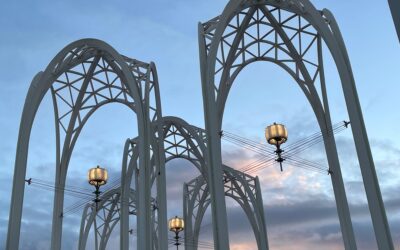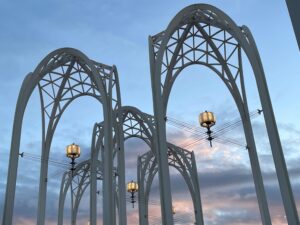
Pacific Science Center to Remove North Gates, Fences, and Ticket Kiosks
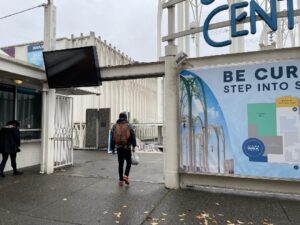
The gates leading into the Pacific Science Center Courtyard are now open to the public
The Pacific Science Center (PacSci) has announced its intention to remove the turnstile gates, fences, and ticket kiosks that have walled off Minoru Yamasaki’s pools and courtyards from the Seattle Center since they were built in 1992. Demolition of these barriers is expected to begin in early 2026, targeting completion by Memorial Day, in time to receive visitors for Seattle’s FIFA World Cup games.
While the barriers are still standing today, the good news is that PacSci opened the pedestrian gates on October 11. From now until full demolition in 2026, visitors will be able to access the courtyard daily from 9:45 AM to 11:00 PM without purchasing tickets. PacSci ticketing has moved to the back of the courtyard.
Even better, PacSci is working on a design that will restore the open appearance of the courtyard as it was first seen by Seattle World’s Fair visitors in 1962. PacSci is not yet ready to unveil artist renderings, but the design is expected to include white see-through fences with Yamasaki’s iconic hourglass pattern metalwork, an extremely wide central open gate which will slide closed at night, and two remnant panels of the pebble-encrusted, tilt-up concrete wall that Yamasaki originally installed to frame the opening, with its large central staircase. The existing handicap ramp at the east end of the entrance will be brought up to current code requirements.
Update on Plans and Budget for the Courtyard and Pools Restoration
At a briefing to Friends of Yamasaki, Historic Seattle, Japanese Community Cultural Center of Washington (JCCCW) and the Queen Anne Historic Society (QAHS) on August 15, PacSci president and CEO, Will Daugherty, noted that the pools started leaking as early as 1963. Before the north pool was drained last year, the pools were leaking approximately 26 million gallons of potable water per year.
Given this unfortunate situation, PacSci has identified four overarching goals for the courtyard’s future: preservation, restoration, sustainability, and accessibility.
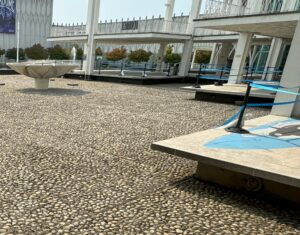
Temporary railings at the floating platforms
The sustainability component includes finding ways to refill the pools without future leakage, and possibly by using non-potable “gray water.” One option is to install a large runoff holding tank under the walkway that connects the central floating terraces with the south pavilion.
The accessibility component refers to the need to bring the courtyard up to current Americans with Disability Act (ADA) standards. In addition to adding ramps where required by current accessibility standards, some form of warnings for visually impaired people must be installed at the edges of the floating terraces, which currently lack guardrails or the type of warning panels found on Link Light Rail platforms. Finding ways to make the courtyard more accessible without compromising Yamasaki’s vision and inspired architectural detailing will be a challenge for PacSci’s talented team of architects, engineers, and landscape architects.
Update on PacSci’s Partnership with Seattle Center and its Restoration Budget
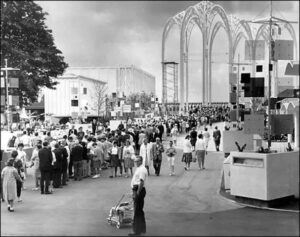
Lines to enter the US Science Pavilion at the 1962 World’s Fair
Raising funds for the four-pronged restoration effort will be a challenge: Will estimates that the courtyard restoration improvements could cost as much as $30 million. In addition, critical improvements to bring the facility’s interiors into compliance with current building codes will raise the total project price tag to around $200 million at a time when PacSci recently faced a budget deficit of $10 million.
The good news is that PacSci’s recently announced partnership with Seattle Center, reported in FOY’s summer 2025 newsletter, should open up sources of public funding for the upgrades. In addition to securing sustained funding from existing county and state funding, a fall 2026 levy for additional earmarked funds is on the table.
PacSci is also planning to take the additional step of reducing costs by selling off some of its peripheral buildings, built long after the 1962 Seattle World’s Fair, that are not covered by the landmark designation. The garage has already been sold to Grousemont Associates, as reported in FOY’s summer 2025 newsletter. Additional buildings that might be sold include the Boeing IMAX theater and the Kraken Presentation Center at the northwest corner of the site.
Planning to leverage public funding, PacSci will also continue to seek funding from private sources, including Amazon, in a public/private partnership.
Celebrating Our Partner Organizations
In this and upcoming newsletters, we are featuring Partner Organizations who have joined our mission. We are profoundly grateful for their invaluable support.
Heritage Regina Joins Friends of Yamasaki

Friends of Yamasaki is proud to partner with Heritage Regina, in the province of Saskatchewan, Canada, celebrating Minoru Yamasaki’s remarkable sense of landscape design and architectural vision. Heritage Regina’s mission is to preserve the city’s historic buildings and sites through stewardship, advocacy, research, public education, and collaboration.
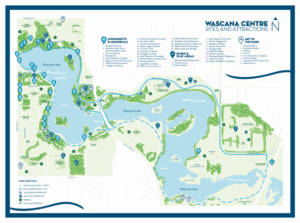
Wascana Centre Sites and Attractions Map
In 1961, Yamasaki was commissioned to prepare a 100-year master plan for Wascana Centre, an urban park that surrounds Wascana Lake, immediately south of Regina’s downtown core. The city of Regina was growing rapidly, and a vision was needed to protect the park from urban encroachment. At the same time, plans were underway for an expanded university within Wascana Centre at the southeast end of the park.
As Jackie Schmidt, President of Heritage Regina explains “his (Yamasaki’s) vision integrated the University and the Provincial Legislature within a design that harmonized the natural landscape with the built environment.” Wascana Centre is one of the largest urban parks in North America and includes the Saskatchewan Legislative Building (1913), Mackenzie Art Gallery, and the Royal Saskatchewan Museum.
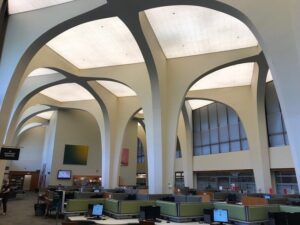
Interior of Yamasaki’s Dr. John Archer Library, University of Regina
Yamasaki was awarded contracts to design three buildings for the University which were built between 1963 and 1967: the Classroom Building, the Laboratory Building, and his revered architectural landmark, the Dr. John Archer Library. As Schmidt affirms, “Regina is fortunate to be home to these enduring landmarks, which stand as a testament to the power of architecture to connect heritage, culture, and community in shaping a city’s identity.”
Friends of Mukai Joins Friends of Yamasaki

Friends of Yamasaki is excited to include Friends of Mukai as a Partner Organization as we celebrate our connections with the Japanese American communities of the Pacific Northwest and our shared missions of restoration and preservation.
Friends of Mukai is a Vashon Island, Washington non-profit organization dedicated to the operation of the historic Japanese American Mukai Farm & Garden. Jade K. Agua is their Executive Director. As stated on their website, “since 2012, Friends of Mukai has worked to secure and preserve the Mukai house, garden, and fruit barreling plant—all constructed almost a hundred years ago.”
The strawberry farm was founded in 1926 by Issei pioneer, B.D. Mukai, who perfected a process to barrel and ship berries long distances. According to their website, “Mukai Farm & Garden represents a blending of two distinct cultures. B.D Mukai, a Japanese immigrant, became a successful Vashon business owner and entrepreneur, while his wife Kuni expressed her ethnic heritage by designing and installing a traditional Japanese stroll garden around their very American-looking home.”
In 1994, the Mukai farm was placed on the National Register of Historical Places. Today, it is a vibrant gathering place that continues to tell the story of the Japanese American berry farms that were once plentiful on Vashon and Bainbridge Islands. Like Minoru Yamasaki, the Mukai family reminds us of the significant and sustained positive impacts of the Japanese American community during the twentieth century and continuing today.
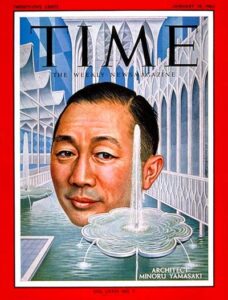
Please encourage your friends and family members to become Friends of Yamasaki. There is no cost to join and you can sign up here: Contact | Friends of Yamasaki